There are currently two moments during the semester to rate your classes : a first indicative feedback during week 5, followed by an in-depth feedback in week 13. Before this system was set up 2 years ago, there was only one opportunity to give a feedback on your classes during week 8 (and for some classes, an additional in-depth feedback in week 13). This older format was criticized : it didn't guarantee to give feedback during the second half of the semester, and didn't allow issues to be dealth with easily in a class, the 8th week of the semester being "too late" to act.
This newer class evaluation format offers a solution to these issues, by providing teachers with a first feedback early in the semester, which gives them time to adjust their lessons, followed by a second round of in-depth feedback after they have completed almost the entire semester. This format was evaluated through a survey conducted by the CAPE and sent to students, teachers and section directors during the 2024 Spring semester. We present here an extract of this survey.
This survey received answers from ~20% of the students (1885 responses), ~25% of the teachers (261 responses) and 14/19 sections. The CAPE considers this sample as representative of the EPFL population, in view of diversity of the sections, study level or role of the respondant.
A first myth that this survey denies is the correlation between the quality of the course and the rate of participation to the feedback (the r-value is very weak)
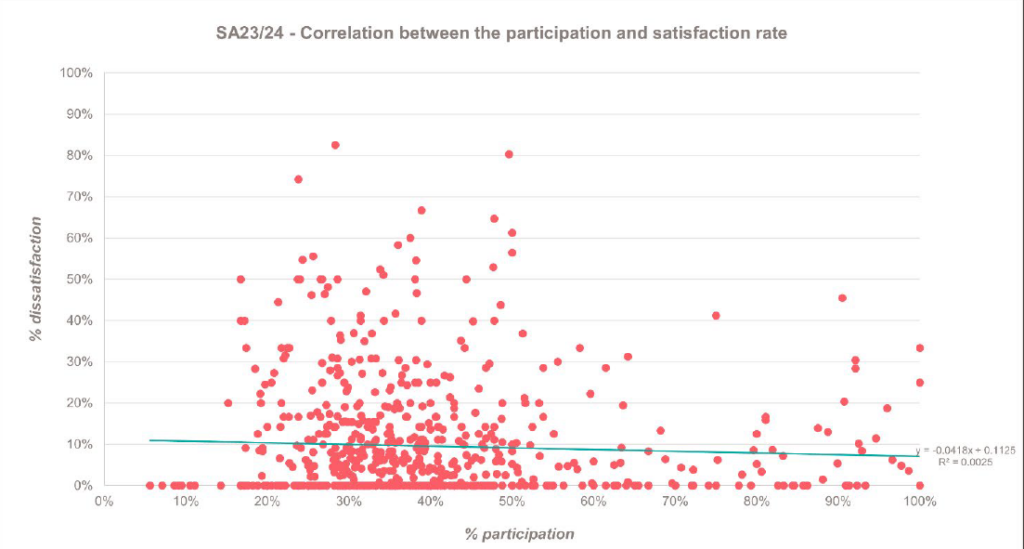
A bad course will not necessarily receive a lot of feedback, and, vice versa, a weak participation rate is not an indicator of a course's good quality.
When it comes to students, the majority of the respondants to the CAPE survey are those who actively participate to the indicative and in-depth feedbacks. The majority of them appreciates this feedback and find an added value.
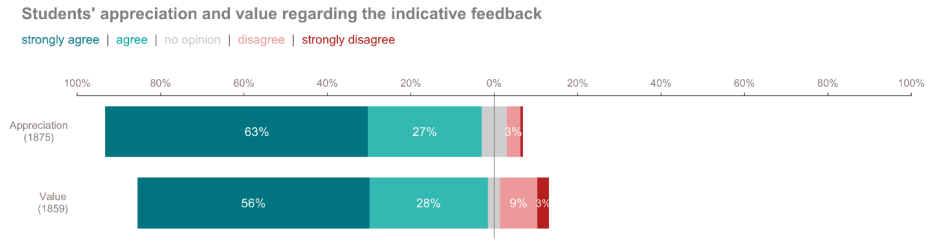
The current timing is also appreciated :
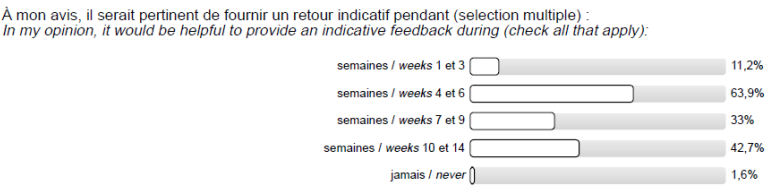
2 big points stood out : complaints toward teachers who do not discuss the results of indicative feedbacks in class, and the lack of questions about the presence in class. We encourage you to remind your teachers to discuss these feedbacks in class ! It is, moreover, mandatory to do so.
The same applies to in-depth feedbacks, who are also appreciated :
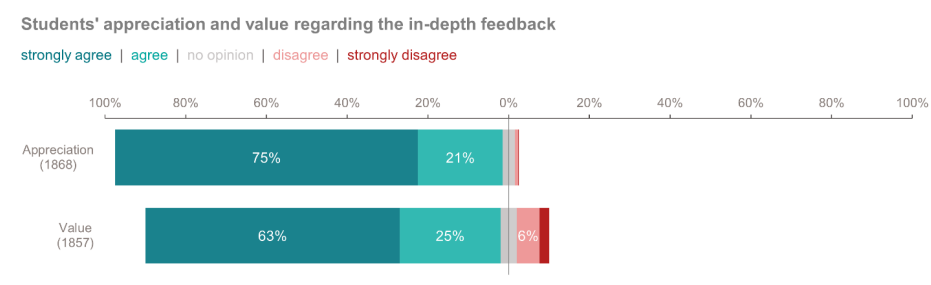
A recurring and important point raised concerned the lack of opportunity to provide in-depth feedback after the course exam. Furthermore, the addition of a question asking whether the teacher had taken into account the mid-semester feedback was suggested.
On the teachers' side, 65% find the indicative feedback useful:
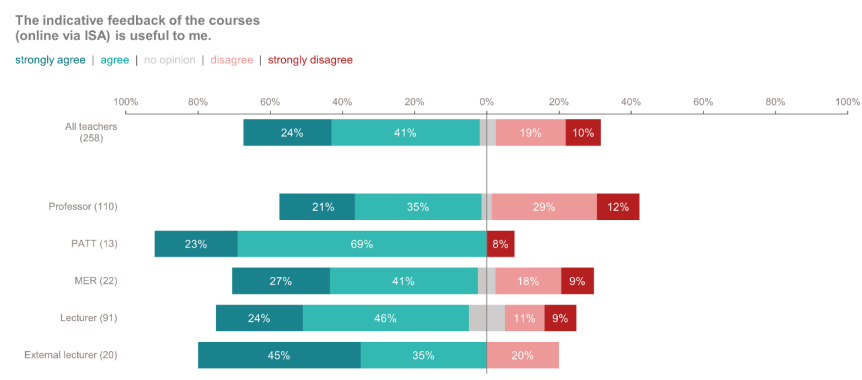
The ordinary teachers, compared to PATT (tenure-track assistant teachers) and other roles, find this feedback less useful. The opinion on the timing of this first feedback is also mixed :
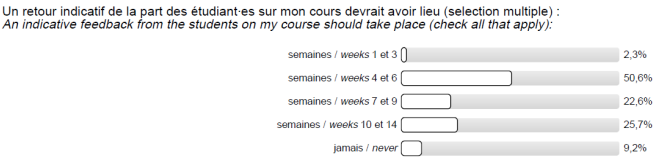
Some teachers find that the 5th week is a good time to act on their courses, whilst others consider it to be too early (not enough metter seen, the TP have not started yet, etc.)
Regarding the in-depth review, opinions on the timing differ from those of the student body.
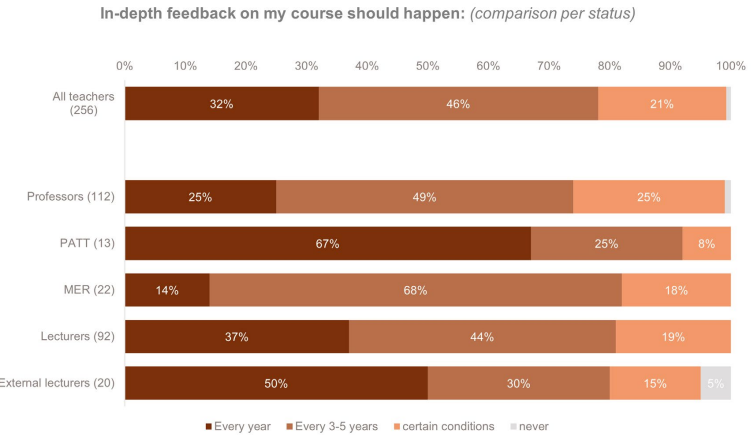
Unlike the student body, the majority of teachers prefer an in-depth review every 3-5 years.
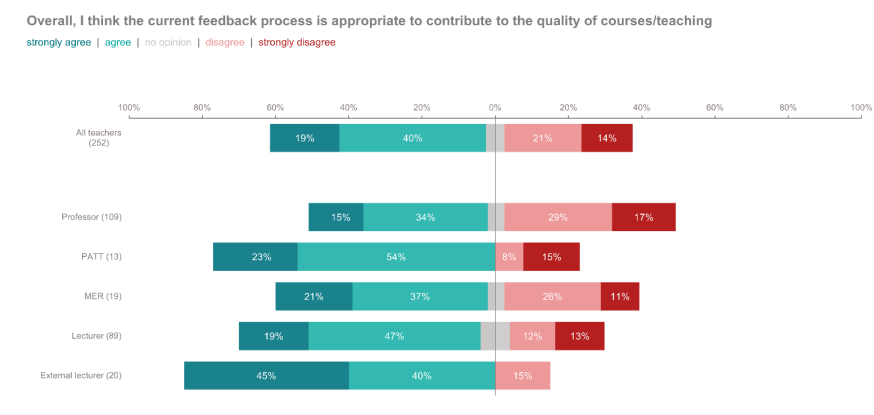
Despite these mixed opinions, at least 92% of the teachers consult both feedbacks and discuss them with their TAs. 82% use the in-depth feedbacks to prepare the next iteration of their course. However, the responses become much more negative when the explicit question of the contribution of feedback to course quality is asked:
Furthermore, several teachers have noted that an excessive demand for feedback from students leads to little feedback, and feedback of low quality.
Finally, the departments found that the new format resulted in a lower administrative burden, especially regarding the monitoring of problematic courses. However, comments were made about the low participation rate, as well as the late availability of feedback reports, which arrive after the completion of course outlines for the following semester and after teachers have begun working on their obligations for the next semester.
In conclusion, the CAPE report on this survey highlights several positive and negative comments from both students and teachers. This report has been forwarded to the new AVPE, which will work on improving the format of course evaluation.